Manufacturing complex metal components efficiently is a constant challenge for engineers and designers. Powder metallurgy parts offer a proven solution that combines precision, material savings, and cost-effectiveness. This guide explores the technology, specifications, and related concepts you need to understand.
What is Powder Metallurgy Parts
Powder metallurgy parts are metal components manufactured by compacting fine metallic powder in a precision die and then heating the compact in a controlled atmosphere furnace. The powder, typically iron-based with alloying additions, flows into a die cavity and is pressed under extreme pressure into a green compact. This compact is then sintered at temperatures below the melting point of the metal.
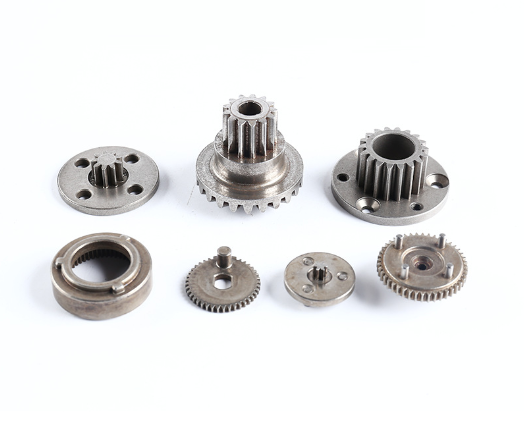
During sintering, the powder particles bond together through atomic diffusion, creating a solid component with useful mechanical properties. The process achieves near-net-shape production, meaning the part emerges from the die and furnace very close to its final dimensions. Minimal secondary machining is required. Powder metallurgy parts range from tiny gears weighing a few grams to large structural brackets exceeding several kilograms. The technology excels at producing complex geometries with integrated features that would be costly to machine conventionally.
3 Specifications of Powder Metallurgy Parts
Understanding these three critical specifications ensures you select the right material and process for your powder metallurgy parts project.
1. Density Level
Density is expressed as a percentage of the theoretical solid density of the material, or directly in grams per cubic centimeter. Standard single-press parts achieve 80 to 90 percent density for ferrous materials. Higher density translates to greater tensile strength, fatigue resistance, and ductility. For structural applications requiring maximum strength, double-press double-sinter processes push density above 92 percent. The specified density directly impacts both mechanical performance and manufacturing cost.
2. Material Grade and Alloy Composition
The base powder determines hardenability, wear resistance, and corrosion performance. Common grades include iron-carbon for general structural use and iron-copper-carbon for improved strength. Nickel and molybdenum additions create high-performance alloys suitable for heat treatment. Stainless steel powders like 316L provide corrosion resistance for medical and marine applications. Each material grade has specific compressibility characteristics that affect achievable density and tooling design.
3. Dimensional Tolerance Class
As-sintered tolerances typically range from plus or minus 0.05 to 0.1 millimeters depending on part size and geometry. A secondary sizing or calibration operation improves precision to plus or minus 0.01 millimeters on critical dimensions. The tolerance class required directly affects manufacturing cost. Specifying tighter tolerances than functionally necessary increases per-part cost without adding value. Always specify only the precision your design truly needs for powder metallurgy parts to perform their function.
Applications of Powder Metallurgy Parts
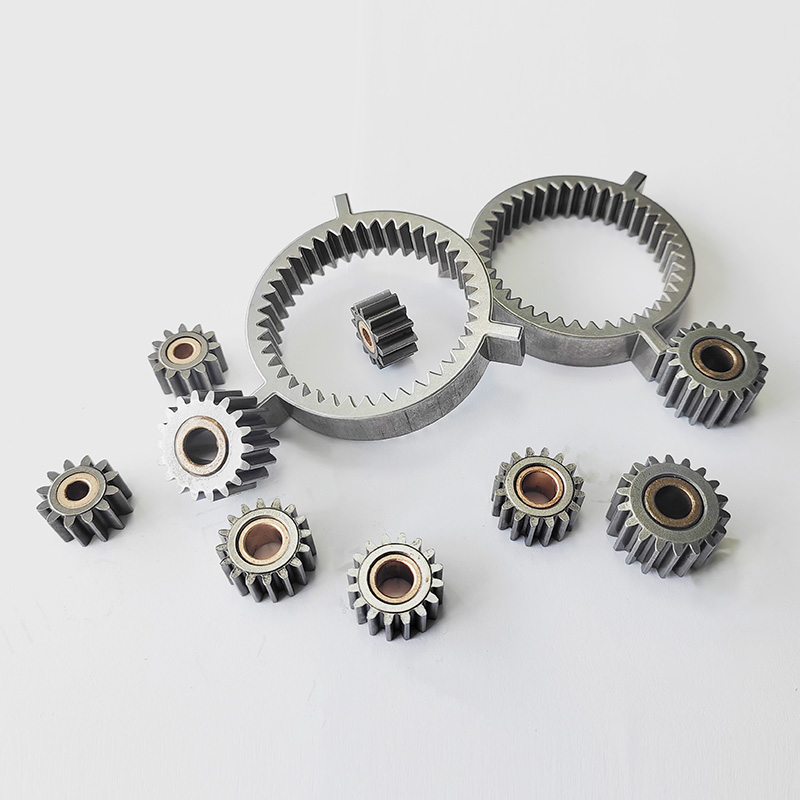
The versatility of powder metallurgy parts has led to their widespread adoption across industries where precision, durability, and cost efficiency are essential. The ability to produce complex shapes with minimal waste makes this technology ideal for high-volume manufacturing.
The automotive industry is the largest consumer of powder metallurgy parts. A typical passenger vehicle contains dozens of sintered components, many of them critical to engine and transmission function. Oil pump gears, camshaft sprockets, and crankshaft timing pulleys are produced in millions annually using powder metallurgy. These parts must withstand high temperatures, continuous rotation, and exposure to engine oil without failure over the vehicle’s lifetime.
Transmission components represent another major automotive application. Synchronizer hubs, clutch plates, and shift forks are manufactured as powder metallurgy parts because the process can integrate complex splines, teeth, and engagement features directly into the pressing. This eliminates costly broaching and hobbing operations required for machined alternatives. Electric power steering systems use sintered gears and sensor rings that provide precise feedback while operating quietly.
Beyond the powertrain, automotive body and chassis applications continue to grow. Seat adjuster mechanisms, window lift gears, and door latch components use powder metallurgy parts for their combination of strength and low noise. Anti-lock brake sensor rings must provide accurate magnetic signals under harsh conditions of dirt, moisture, and temperature cycling. Powder metallurgy delivers the required magnetic properties and dimensional precision at a fraction of the cost of alternative manufacturing methods.
The power tool industry relies heavily on powder metallurgy parts for both professional and consumer products. Cordless drills, angle grinders, and circular saws contain sintered gear sets that transmit high torque in compact housings. These gears experience shock loading when a drill bit binds or a saw blade stalls. The ability to impregnate powder metallurgy parts with lubricating oil provides self-lubrication throughout the tool’s service life, eliminating the need for periodic maintenance by the user.
Home appliances feature powder metallurgy parts in numerous applications. Washing machine transmissions use sintered gears and cams that operate reliably for thousands of cycles. Dishwasher pump components resist hot water and detergent exposure. Refrigerator compressor parts benefit from the material efficiency of powder metallurgy, which keeps manufacturing costs low for these mass-produced consumer goods. The low noise signature of well-designed sintered gears is particularly valuable in home environments.
Lawn and garden equipment manufacturers choose powder metallurgy parts for riding mower transaxles, snowblower auger gears, and chainsaw drive sprockets. These outdoor power applications demand high strength and wear resistance at competitive price points. Sintered components meet these requirements while eliminating many secondary machining steps.
The medical device industry has embraced powder metallurgy parts for surgical instruments, orthopedic implants, and diagnostic equipment components. Stainless steel powders produce biocompatible parts with complex geometries. Dental brackets, forceps hinges, and implantable device housings benefit from the near-net-shape capability and material consistency of powder metallurgy.
Industrial machinery applications include hydraulic pump components, pneumatic cylinder parts, and conveyor system bearings. Self-lubricating sintered bearings operate for years without external lubrication in hard-to-reach locations. Lock mechanisms, ratchet gears, and indexing cams produced as powder metallurgy parts provide reliable service in demanding factory environments.
The renewable energy sector represents a growing market for powder metallurgy parts. Wind turbine pitch control mechanisms, solar tracker gearboxes, and hydroelectric generator bearings all use sintered components. The combination of high strength, wear resistance, and cost efficiency makes powder metallurgy attractive for these large-scale energy applications where reliability and long service life are paramount.
Related: Sintering Furnace Technology and Atmosphere Control
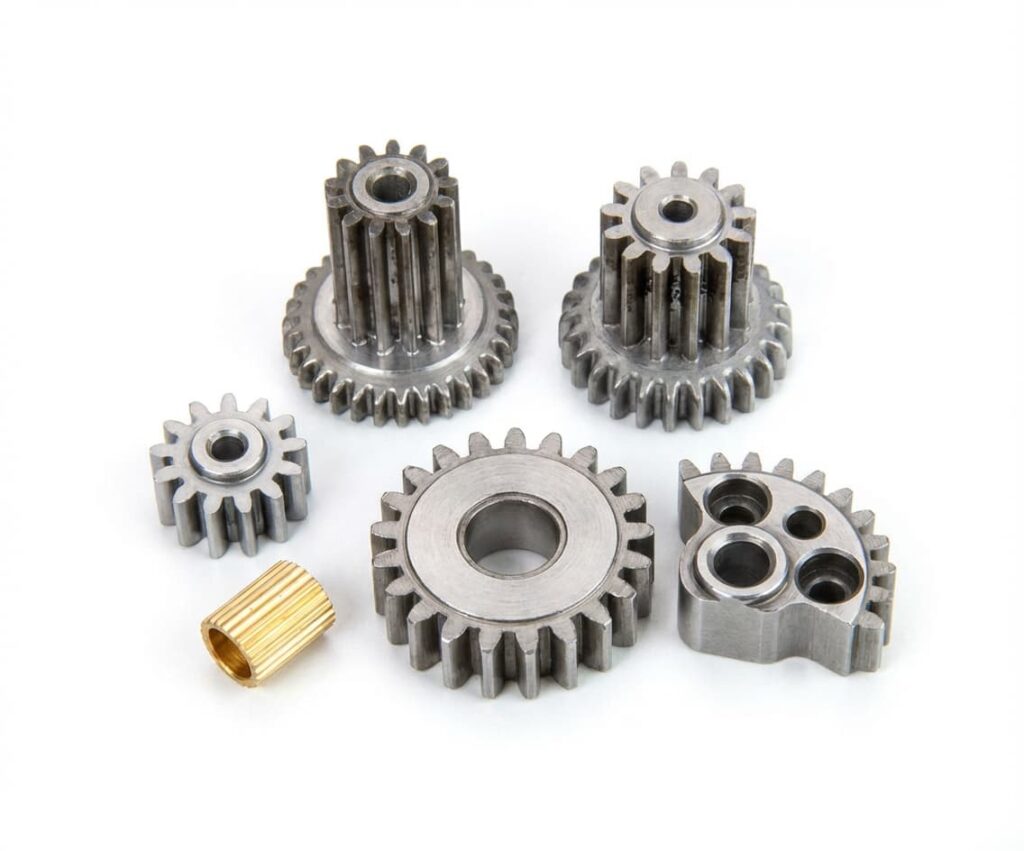
Sintering transforms the fragile green compact into a strong, durable metal component. The furnace technology and atmosphere control directly determine the quality of powder metallurgy parts.

Continuous mesh-belt furnaces handle high-volume production efficiently. Green compacts travel on a woven metal belt through distinct thermal zones. The first zone, typically held around 400 to 600 degrees Celsius, burns off the pressing lubricant. This delubrication step must proceed gradually to prevent soot formation within the pores. The second zone raises the temperature to sintering range, typically 1100 to 1150 degrees Celsius for ferrous materials. Atomic diffusion creates metallurgical bonds between particles, and any alloying additions like copper melt and infiltrate the iron particle boundaries.

The sintering atmosphere protects the metal from oxidation and controls carbon content. A mixture of nitrogen and hydrogen is common, with hydrogen reducing any surface oxides that formed before the parts entered the furnace. The dew point of the atmosphere is monitored continuously; too high a dew point causes decarburization that weakens the surface of powder metallurgy parts. Some alloys require vacuum sintering for the highest purity and corrosion resistance, particularly stainless steels.

The cooling zone determines the final microstructure. Slow cooling produces ferrite and pearlite structures that are relatively soft and machinable. Accelerated cooling using convection or gas quenching creates harder, stronger microstructures through sinter-hardening. This eliminates the need for a separate heat treatment cycle for many powder metallurgy parts. The cooling rate must be uniform across the belt width to prevent distortion from uneven thermal contraction.
FAQ: Your Powder Metallurgy Parts Questions Answered
1. How do powder metallurgy parts compare in strength to machined steel?
Modern high-density powder metallurgy parts can match the tensile and fatigue strength of wrought steel when processed to density above 92 percent. Surface densification techniques close the pores on gear flanks and bearing journals, achieving contact fatigue resistance comparable to cut and ground steel. For the highest strength applications, heat treatment after sintering produces martensitic microstructures with hardness exceeding 60 HRC. The key is specifying adequate density and appropriate heat treatment for the load conditions.
2. What shapes are possible with powder metallurgy parts?
The process produces shapes that can be ejected from a rigid die in the pressing direction. Spur gears, cams, sprockets, brackets, and bushings are common. Features like blind holes, bosses, splines, and keyways can be pressed directly. Undercuts and cross-holes perpendicular to the pressing direction cannot be formed and require secondary machining. The maximum part size is limited by press tonnage capacity, typically around 150 millimeters in diameter. Wall thickness should be at least 1.5 millimeters for adequate powder fill and green strength.
3. What surface finish can I expect from powder metallurgy parts?
As-sintered surfaces have a matte appearance with roughness typically around 0.8 to 1.6 micrometers Ra. This surface is excellent for oil retention in self-lubricating bearings. Sizing or calibration operations burnish the surface, reducing roughness and creating a smooth, shiny finish on dimensional features. Tumbling and vibro-deburring remove sharp edges and improve overall surface appearance. If a mirror finish is required, grinding or honing can be applied as secondary operations on critical surfaces.
Conclusion
Powder metallurgy parts represent a mature, versatile manufacturing technology that delivers precision, material efficiency, and cost advantages across countless industries. By understanding the critical specifications of density, material grade, and dimensional tolerance, you can design components that leverage the full potential of this process. The compaction and sintering stages each offer multiple process variables to optimize for specific performance requirements. Whether you need high-volume automotive gears, corrosion-resistant medical instruments, or wear-resistant industrial bearings, powder metallurgy parts provide a reliable, proven pathway from powder to finished component.
8 Tips to Find Great Powdered Metal Companies for Your Project