Engineers constantly search for ways to cut costs without sacrificing precision or durability. Powder metal gears deliver exactly that combination, offering a near-net-shape manufacturing process that produces strong, accurate gears with minimal material waste. This article explores why these components deserve a place in your next project.
What is Powder Metal Gears
Powder metal gears are precision mechanical components manufactured by compacting fine metallic powder under extreme pressure and then heating it in a controlled furnace below the melting point. This process, called powder metallurgy, fuses the individual particles into a solid, durable gear with the tooth profile already formed. The gear emerges from the die nearly complete, requiring minimal finishing work.
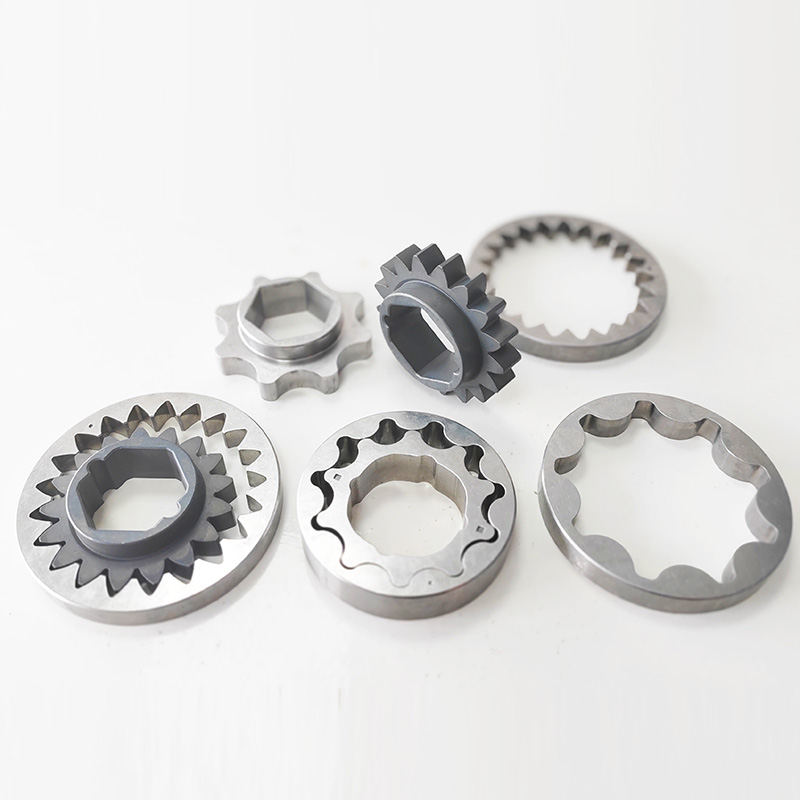
Unlike traditional cut gears, which start as a solid blank and have material machined away, the powder metal gear build the shape from the ground up. The teeth, bore, and any hubs or flanges are all pressed into existence simultaneously. This approach allows for complex geometries and integrated features that would be costly or impossible to machine conventionally, making these gears a staple in high-volume automotive and industrial applications.
3 Specifications of Powder Metal Gears
To specify the metal gears correctly, you must understand three critical parameters that govern their performance and manufacturability.
1. Density Level
Density is the most fundamental specification, expressed as a percentage of theoretical solid density or in grams per cubic centimeter. Standard single-press powder metal gears typically achieve 6.8 to 7.1 g/cm³ for iron-based materials, representing roughly 88 to 92 percent density. Higher density translates directly to greater tensile strength and fatigue resistance. For demanding applications, advanced processes like double-press double-sinter or copper infiltration can push density above 7.4 g/cm³, closing internal pores and dramatically increasing load-bearing capacity.
2. Material Grade and Alloy Composition
The base powder composition determines hardenability, wear resistance, and strength. Common grades include iron-carbon for basic structural gears and iron-copper-carbon for improved strength. Nickel and molybdenum additions create high-performance alloys suitable for case hardening. The MPIF standard designations, such as FC-0208 or FN-0405, define precise chemistry and minimum properties. Selecting the correct material grade ensures your powder metal gears meet the required bending fatigue and contact stress limits for the intended service life.
3. Tooth Quality and Accuracy Class
Tooth profile accuracy is measured according to AGMA or ISO gear quality standards. Most as-sintered metal gears achieve AGMA class 6 to 8 accuracy. A secondary sizing or calibration operation can improve this to class 9 or 10 by repressing the teeth to correct thermal distortion. For noise-sensitive applications like automotive power windows or office equipment, the tooth quality class directly impacts acoustic performance. Always specify the required accuracy class and the measurement standard on your drawing.
Advantages of Powder Metal Gears
Powder metal gears offer a compelling set of benefits that make them the preferred choice for many high-volume applications. These advantages extend beyond simple cost reduction.
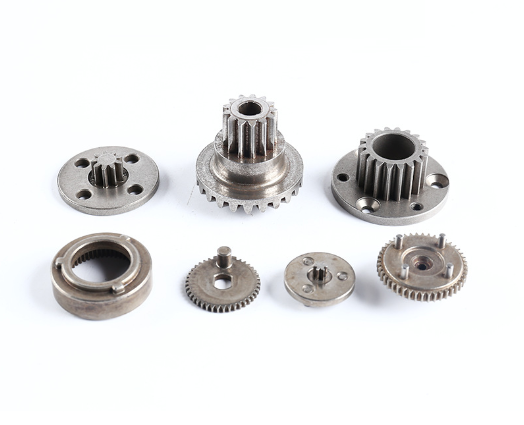
The most significant advantage is material efficiency. Traditional gear cutting starts with a solid blank and removes up to 50 percent of the material as chips. Sintered metal gears use over 97 percent of the raw powder, turning nearly every gram of material into finished product. This efficiency reduces raw material costs and aligns with sustainable manufacturing goals.
Another critical advantage is design consolidation. A powder metal gear can integrate multiple features in a single pressing. The bore, keyway, hub, flange, and even cam profiles can all be formed simultaneously. This eliminates separate machining operations and reduces assembly part count. A single powder metal gear can replace an assembly of two or three conventionally machined components.
Consistent quality and repeatability set sintered metal gears apart in mass production. Once the tooling is validated, every gear pressed through that die exhibits identical dimensions. There is no tool wear in the traditional cutting sense because the powder is pressed, not cut. This consistency means fewer quality rejects and more predictable assembly line performance.
Self-lubrication capability is a unique advantage not available with cut gears. The controlled porosity of powder metal gears can be impregnated with oil. Under operating temperature and centrifugal force, this oil migrates to the tooth surface, providing continuous lubrication. This feature is invaluable for applications where regular maintenance is difficult, such as power tools and sealed gearboxes.
Finally, sintered metal gears offer excellent vibration dampening. The residual porosity within the material absorbs vibrational energy, reducing gear noise compared to fully dense wrought steel. This inherent damping characteristic makes sintered metal gears particularly attractive for office automation equipment and home appliances where quiet operation is a selling feature.
Applications of Powder Metal Gears
The versatility of powder metal gears has led to their adoption across numerous industries where reliability, cost-effectiveness, and performance intersect.
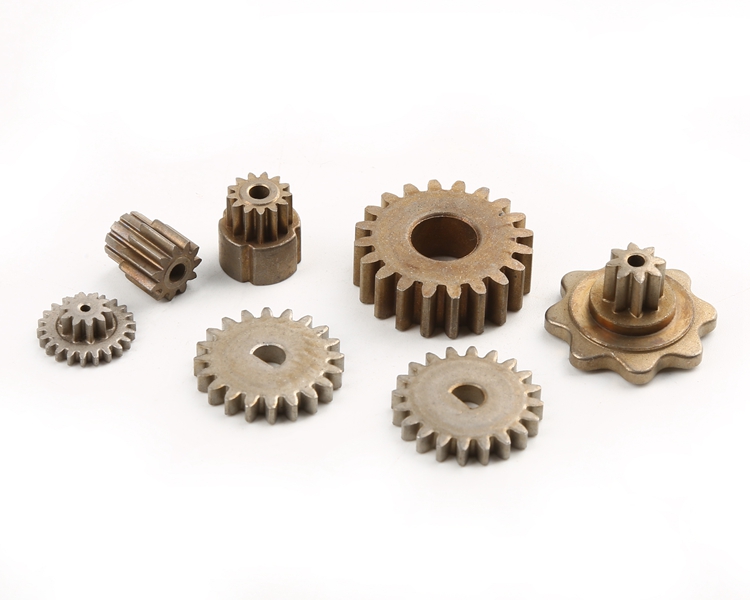
The automotive industry is the largest consumer of powder metal gears. Engine oil pump gears, camshaft sprockets, and crankshaft timing gears are produced in millions annually. Power seat adjusters, window lift mechanisms, and sunroof drives all rely on sintered gears for quiet, reliable operation. Electric power steering systems use high-strength powder metal gears that withstand significant torque loads while maintaining precise steering feel.
Power tool manufacturers depend heavily on sintered metal gears. Cordless drills, angle grinders, and circular saws all contain sintered gear sets. These gears must withstand high shock loads and rapid speed changes. The ability to impregnate them with lubricant ensures they survive the demanding conditions of construction sites and workshops without premature failure.
Home appliances feature powder metal gears extensively. Washing machine transmissions, dishwasher pumps, and blender drive trains all use sintered gears. The low noise signature and self-lubricating properties are particularly valuable in these applications where consumers expect quiet, maintenance-free operation for years.
Lawn and garden equipment such as riding mower transaxles and snowblower gearboxes use large sintered metal gears. These applications require high strength and wear resistance at a cost that keeps the final product affordable. Sintered gears meet these requirements while eliminating the need for gearbox oil changes.
FAQ: Your Powder Metal Gears Questions Answered
1. Can powder metal gears handle the same loads as machined steel gears?
Yes, when designed correctly and manufactured to high density. Modern high-density sintered metal gears with density above 7.3 g/cm³ and proper heat treatment can match the bending fatigue strength of wrought steel gears. Surface densification technology can close the pores on the tooth flank, providing contact fatigue resistance comparable to cut and ground gears. The key is specifying the correct material grade and density for your specific load case.
2. Are powder metal gears suitable for high-speed applications?
They can be, with proper design considerations. The porosity in standard sintered metal gears limits their thermal conductivity, which can cause heat buildup at very high speeds. However, gears intended for high-speed use can be made with high-density processing and specialized alloy compositions. For extremely high-speed applications above 10,000 RPM, consult with the manufacturer about copper infiltration or surface densification to close the pores and improve heat transfer.
3. What is the typical tooling cost for powder metal gears?
Tooling cost depends on gear complexity, size, and number of levels. A simple spur gear with a single hub might require tooling costing a few thousand dollars. Complex multi-level gears with helical teeth and intricate features can cost significantly more. However, this tooling typically lasts for hundreds of thousands of parts. When amortized over the production volume, the per-piece tooling cost becomes very economical. Discuss your expected annual volume with the supplier to understand the true cost picture.
Conclusion
Powder metal gears represent a proven, reliable technology that combines material efficiency with excellent mechanical performance. Their ability to consolidate multiple features into a single pressing, coupled with self-lubrication and vibration damping properties, makes them invaluable across automotive, power tool, and appliance industries. By understanding the critical specifications of density, material grade, and tooth quality, you can confidently specify sintered metal gears for your next high-volume application and enjoy significant manufacturing advantages.
6 Reasons to Partner with Great Small Powder Metal Suppliers